Rome Behind the Scenes: The Machine — Trajan’s Markets, when Rome stops being just a backdrop
I used to brush past Trajan’s Markets every day: glimpsed from the bus window, caught sideways as I rushed somewhere else, like a constant murmur you eventually stop hearing. The brickwork climbing up behind the Forums had become part of the scenery, invisible through sheer over-familiarity. How was it possible that in twenty-six years I’d never once stepped inside? Crossing that threshold brought a sharp realisation:
I couldn’t understand how I’d stayed indifferent to that kind of wonder for so long. From that moment, that part of Rome stopped being just a backdrop.
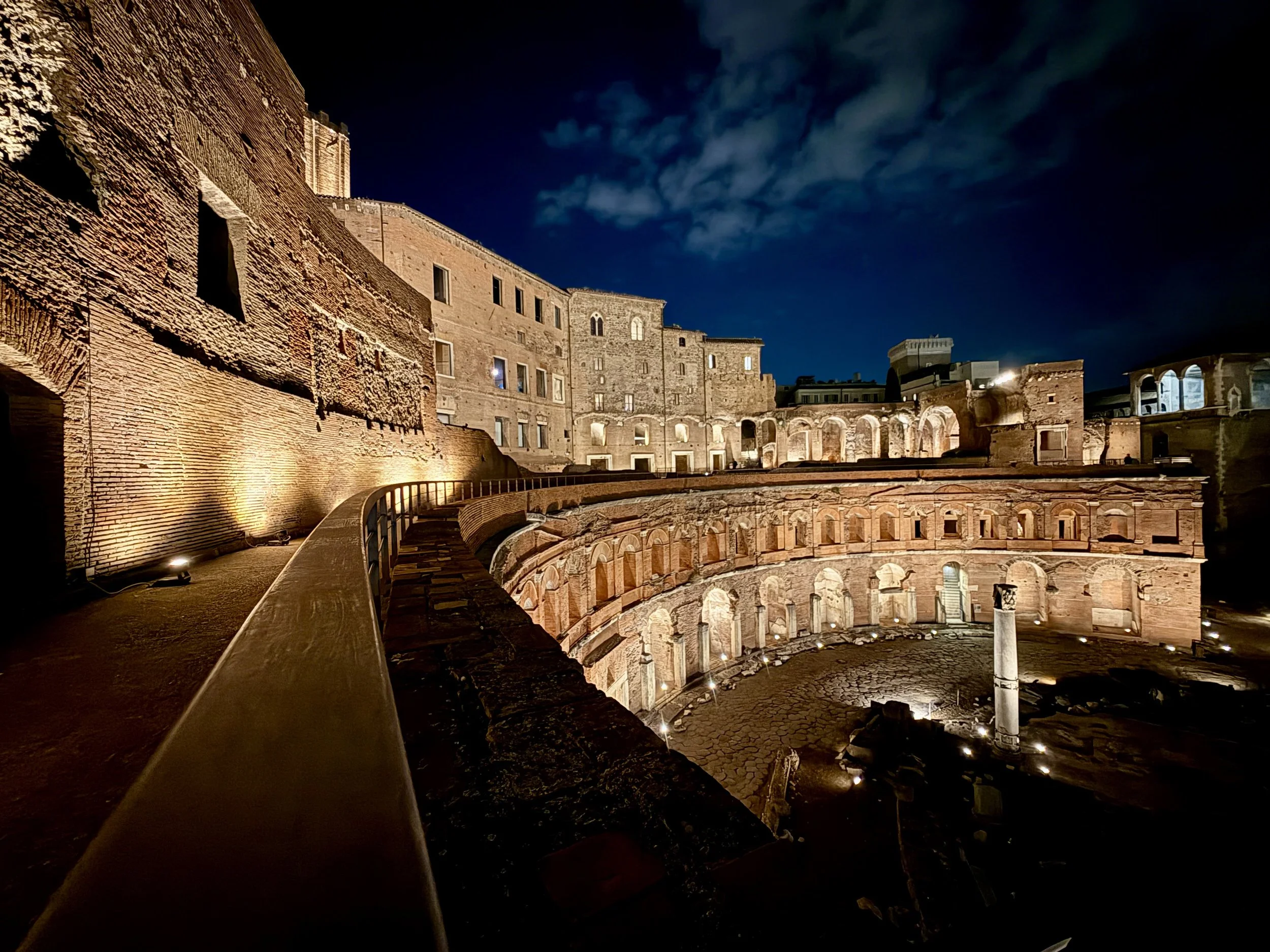
These aren’t romantic ruins; they’re a machine. Six storeys climb up the Quirinal. Interior spaces open out and stitch themselves back together; ramps lock different levels into place; a covered gallery links rooms and functions. As you walk, you realise the plan was drawn to keep people, goods and documents moving, like a contemporary shopping centre – except the idea was born here two thousand years ago. Not a local street market with overlapping voices, but the operational back room of imperial Rome: tabernae on the street front and, above all, storerooms, offices and archives serving the great Forum of Trajan. Grain, oil, cloth and spices reached Rome through a capillary system of ports, warehouses and administrations. The Markets belong to that network: not the shopfront, but the mechanism that makes the rest possible.
The Via Biberatica, a medieval name that carries the flavour of glasses and pauses, cuts through the complex like an artery: it binds upper and lower levels together and gives the place its urban scale. Steps worn down by centuries of feet, thresholds polished by passage, brickwork that tells of repairs and changes of use: here a workshop, there a blocked corridor, layers looking out over one another. From the terraces, your gaze opens over Trajan’s Forum like a life-size plan. Solids and voids fall into place, and it becomes easy to see where the temple ended and the portico began.
What feels modern here is the way the building works. You see it in section: floors in conversation with one another, openings that carry light and air deep inside, routes designed to keep people and goods flowing. It’s a building that thinks about the city and organises it; that’s why it is still contemporary, then as now. If the word ‘shopping centre’ feels like heresy alongside the ancient, just follow the routes and notice how they lead you on, the principle is the same: a covered spine along which people and functions meet.
For centuries this machine underpinned imperial Rome; when that order shifted, the structure did not disappear, it simply allowed itself to be used differently. In the Middle Ages it truly became lived-in: the Biberatica turned into a real street, houses leaning against the ancient walls, workshops, cellars cut into the tufa, the Torre delle Milizie rising out of the Roman structures as if it were the most natural thing in the world and it is. Rome works through reuse, adaptation, stratification. What strikes you is the continuity: warehouses turning into dwellings, imperial offices turning into medieval shops, functions changing skin without changing meaning. I walk and think of the officials, traders and residents who have taken these paths, and now me. It’s not an abstract idea, it’s matter that endures.
I lean out from above: below, the Forums seethe, the noise reaching me only in a muffled wash. I turn back into the quiet of the Markets, the spectacle in the foreground and the hidden back-stage, both necessary, but today it’s what lies behind that interests me more. The name that returns here is Trajan’s, and the mind that gives it form is Apollodorus of Damascus, engineer and architect able to map an idea of the city, not just design individual buildings. In that alliance the Markets find their clarity: a machine that thinks and acts, without showiness.
Perhaps that’s why I stay: not for some romantic notion of the Eternal City, but for the discovery that Rome can still shift you a millimetre, just enough to show you what is working away beneath the image. You don’t need to go far, you need to look. Trajan’s Markets whisper it without insisting: these walls have been standing for two thousand years not through magic, but because they were well built. They go on telling anyone willing to listen that this has never only been the city of the Caesars, it has always also been the city that works behind the scenes, that organises, that holds things together.
When you do go, don’t look for the show: look for the back-stage. Go in slowly, follow the ancient routes, let the galleries carry you from one level to the next, climb up to the terraces and find your own distance. And if you feel like seeing Rome at this pace, unhurried, searching for details that never make it into the guidebooks, you can reach La Casa al Colosseo with a leisurely walk. Sometimes all it takes is crossing a threshold you’ve always ignored to discover you can still fall in love.