The House Before the House
A story of restoration that reveals, not replaces
Picture and media production: Marco Joe Fazio Studio
When I first stepped into this early twentieth-century home, I had a clear, almost physical sensation: it was not asking to be changed, it was asking to be listened to.
There was silence, but not neglect.
The walls, the floors, the traces of time, each spoke in their own way, quietly yet insistently.
Some rooms had been mistreated by makeshift lofts built to “gain space”, but they had taken away the one thing I value most, the breath of high ceilings.
They felt like rooms that had lost their voice, waiting patiently to be seen again.
They did not cry out, they simply waited.
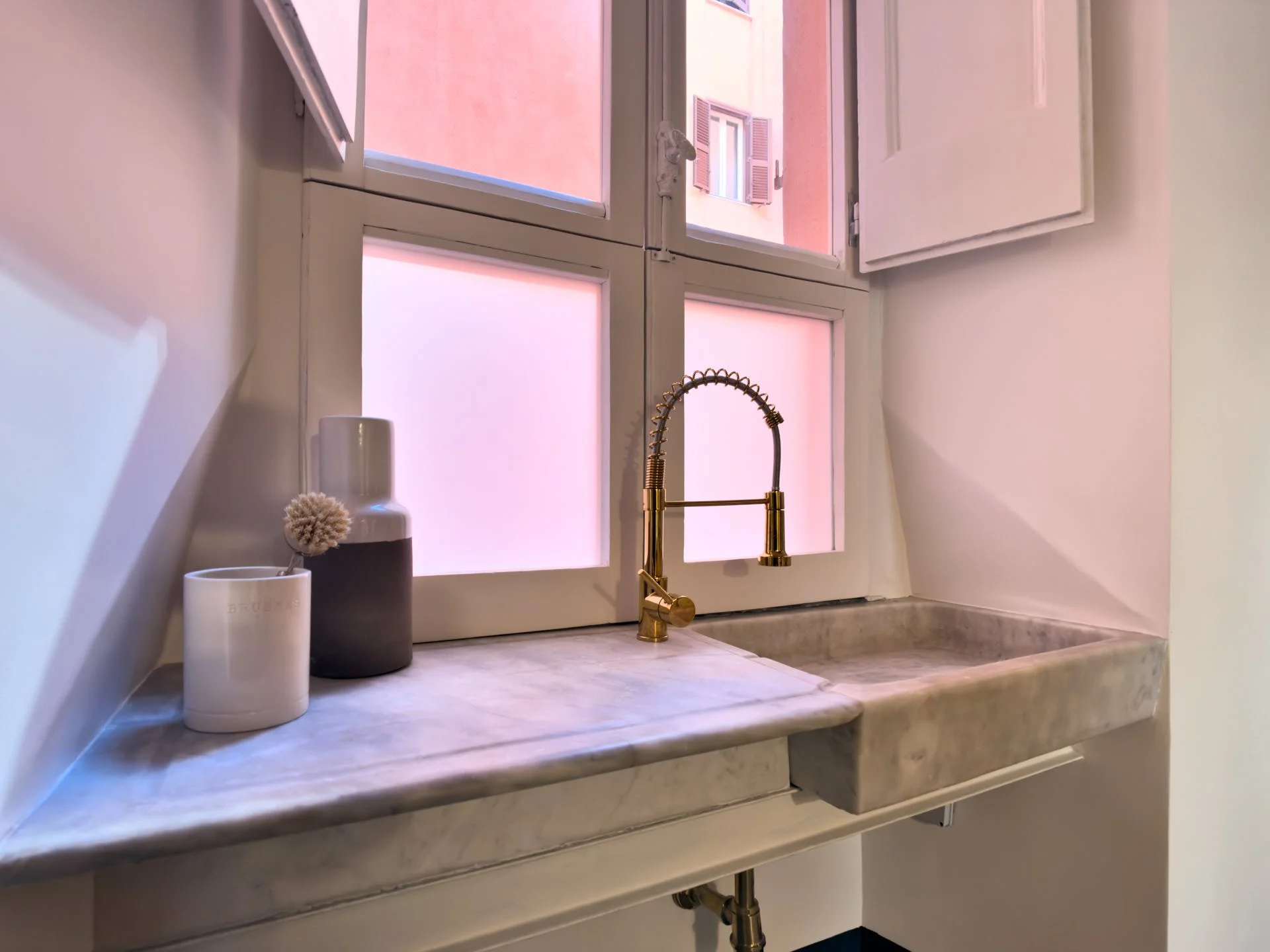
Among the many things I dealt with during this restoration, one in particular stopped me in my tracks, an old marble sink.
Large, heavy, real.
It had been trapped within a modern black countertop, built not to hide it, but to reduce it to pure function.
Perhaps an attempt to adapt it to a time that moved faster than its own.
Someone, years ago, had chosen to keep it without truly seeing it.
Someone else might have removed it without much thought.
It would have been quicker, easier.
I, instead, felt that within that object there was something to save, perhaps not something useful, but something necessary.

I had it carefully removed and taken to Vitaliano, a well-known Roman marble craftsman, an artisan who works in silence and listens to the material with his hands.
I asked only one thing of him, do not make it something else, give it back its voice.
And so it was.
Today, the sink has come home again, with its imperfections, its marks, the traces of time. It stands beneath a window that opens onto the inner courtyard, where the afternoon light reflects the soft pink hue of the building’s walls.
Every day its tone changes, sometimes warmer, sometimes more milky, sometimes almost golden.
It is as if time flows around it, yet it remains still, aware of itself.
It has returned to being what it has always been, a point of water, of work, of domestic life, but also of simple beauty, the kind that does not impose itself.
It is not decorative, it is not nostalgic, it is an act of respect.
“It is not time that wears things away, it is the distracted gaze of those who stop seeing them”
Today, many mistake speed for efficiency, and replacement for improvement.
But sometimes to restore means simply to stop, to look, to recognise that what was once made with care does not need to be reinvented, only rediscovered.
Perhaps it was that very sink, together with the original floors, of which I will soon speak, that made me say, I want this house.
Because behind everything that seemed ruined, I saw something alive, a story still continuing, a time that had not stopped but slowed down, waiting.
The quiet acceptance that things carry their own duration, and that this should not be corrected, but embraced.
Why I Tell This Story
Because in a world that tends to start over from scratch, I chose to slow down, to let things tell me their story before writing a new one together.
Because hospitality, to me, also means this, living with respect.
Would you like to stay in a home with a soul?
Here, every detail has been considered, yet nothing feels contrived.
From the marble sink reflecting the soft pink light of the courtyard, to the original floors that still hold the pace of time.